

The shift: from search bars to conversations
A few years ago, if you wanted trail running shoes, you typed “best trail running shoes” into Google, scanned the top results, and clicked around. Today, a growing number of shoppers skip the search bar entirely. They ask an AI assistant instead.“What are the best trail running shoes for someone just starting out? My budget is under $150.”ChatGPT, Gemini, and similar tools answer in plain language — naming specific brands, explaining trade-offs, and often linking to sources. The shopper gets a curated shortlist rather than ten blue links. This shift is called AI-powered product discovery, and it is changing how brands win (or lose) customers at the very top of the funnel.
How AI assistants decide what to recommend
When a shopper asks an AI for a product recommendation, the assistant does not run a live search and rank pages. It synthesizes an answer from everything it was trained on — product data, reviews, editorial articles, brand websites, and cited sources — and names the brands it believes are most relevant and trustworthy for that query. What the AI weighs:- Product relevance — Does your catalog clearly match what the shopper asked for? Are your product titles, descriptions, and attributes specific and accurate?
- Authority — Do reputable sources (reviews, editorial coverage, trusted retailers) mention your brand in the context of this query?
- Readiness — Is your product data complete and structured in a way AI models can use? Schema markup, pricing, availability, and rich descriptions all matter.
This is different from classic SEO
In traditional SEO, you compete for page-1 rankings. A shopper sees ten results and might click several. You can still win customers from positions 3, 5, or even 7. In AI search, the response typically names two to five brands. If your brand is not in that list, you are invisible. There is no page 2 to fall back on.
This is why the category is called Generative Engine Optimization (GEO) — it is the discipline of making your brand visible inside AI-generated answers, the same way SEO made your pages visible in search results.
What GEO means in practice
GEO is not a single tactic. It covers everything that influences whether an AI names your brand:- Product data quality — Complete, accurate, detailed catalog content.
- Structured data — Schema markup that makes your products machine-readable.
- Authority building — Getting your brand mentioned in the sources AI models trust: review sites, editorial coverage, and relevant communities.
- Content depth — Buying guides, comparison articles, and use-case content that teaches AI models what problems your products solve.
GEO does not replace SEO — it extends it. Better product data and richer editorial coverage help you in both traditional search and AI-powered discovery.
Where Citd fits in
You cannot improve what you cannot measure. That is Citd’s job. Citd tracks real buyer queries — like “best trail running shoes under $150” — across AI assistants. It records which brands get named, where they appear, and what sources are cited. Then it compares your performance against your competitors and tells you exactly which gaps to close first.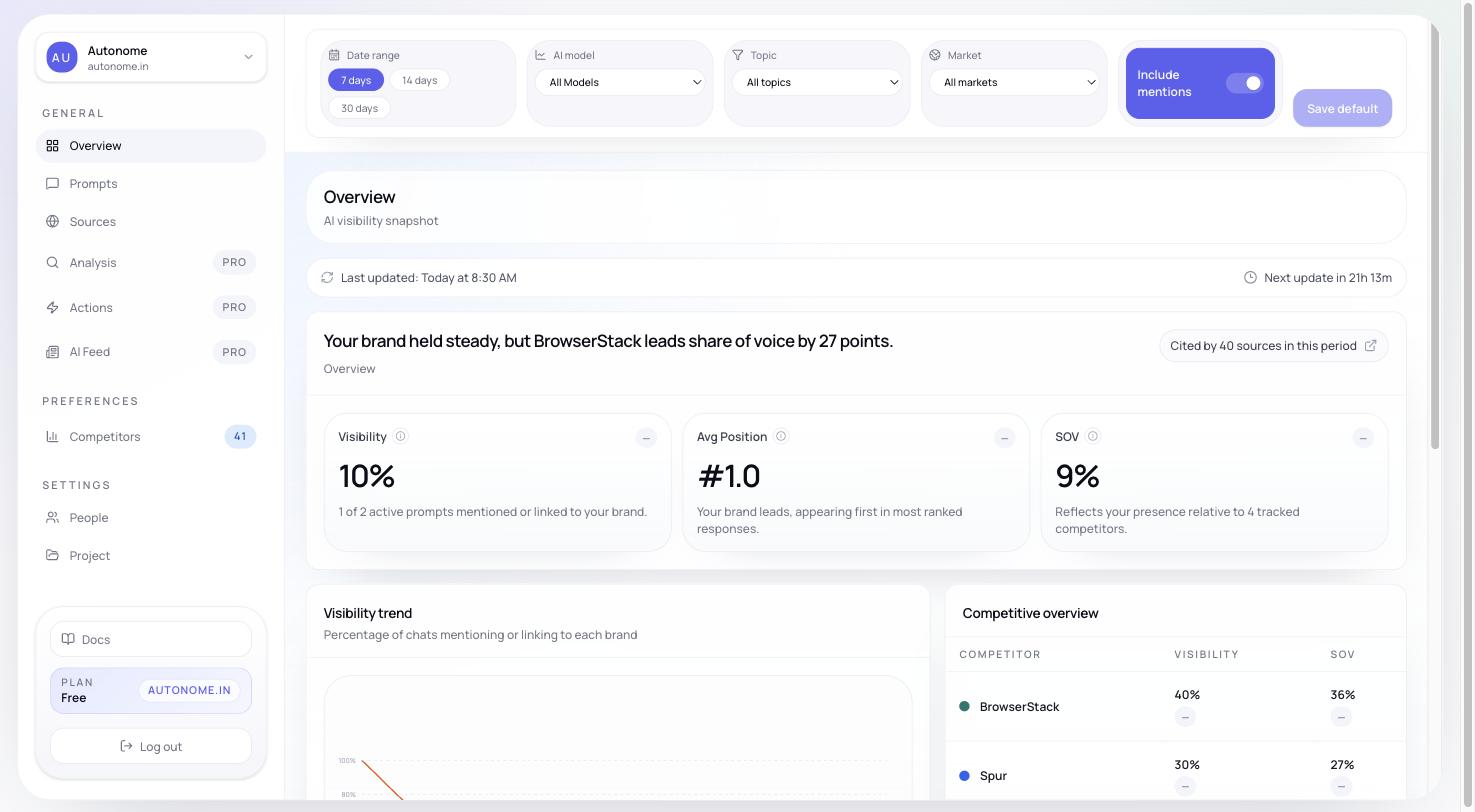
Citd tracks AI shopping prompts and shows you who gets recommended
- Am I being recommended? — Visibility and Share of Voice tell you your reach and your share of the conversation.
- Who is beating me, and why? — Competitors and Analysis break down Authority, Relevance, and Readiness gaps.
- What do I fix first? — Actions prioritizes improvements so you spend effort where it has the biggest impact.
- Which sources does the AI cite for my category? — Sources shows which domains and URLs appear when AI assistants justify recommendations in your space.
A concrete example
Imagine you sell trail running shoes. A shopper asks ChatGPT: “best trail running shoes for technical terrain under $150.” The AI responds with three brands. Yours is not one of them. Citd shows you:- Your Visibility for trail running shoe prompts is 20% — you appear in only 1 in 5 tracked queries.
- The brands that do appear are cited from gear review sites and running communities where you have no coverage.
- Your product descriptions lack terrain-specific language that the winning brands use.
Next steps
Quickstart
Set up your project and get your first AI visibility results in minutes.
Core Concepts
Learn about the metrics, prompts, topics, and shopping modes that make up Citd.