

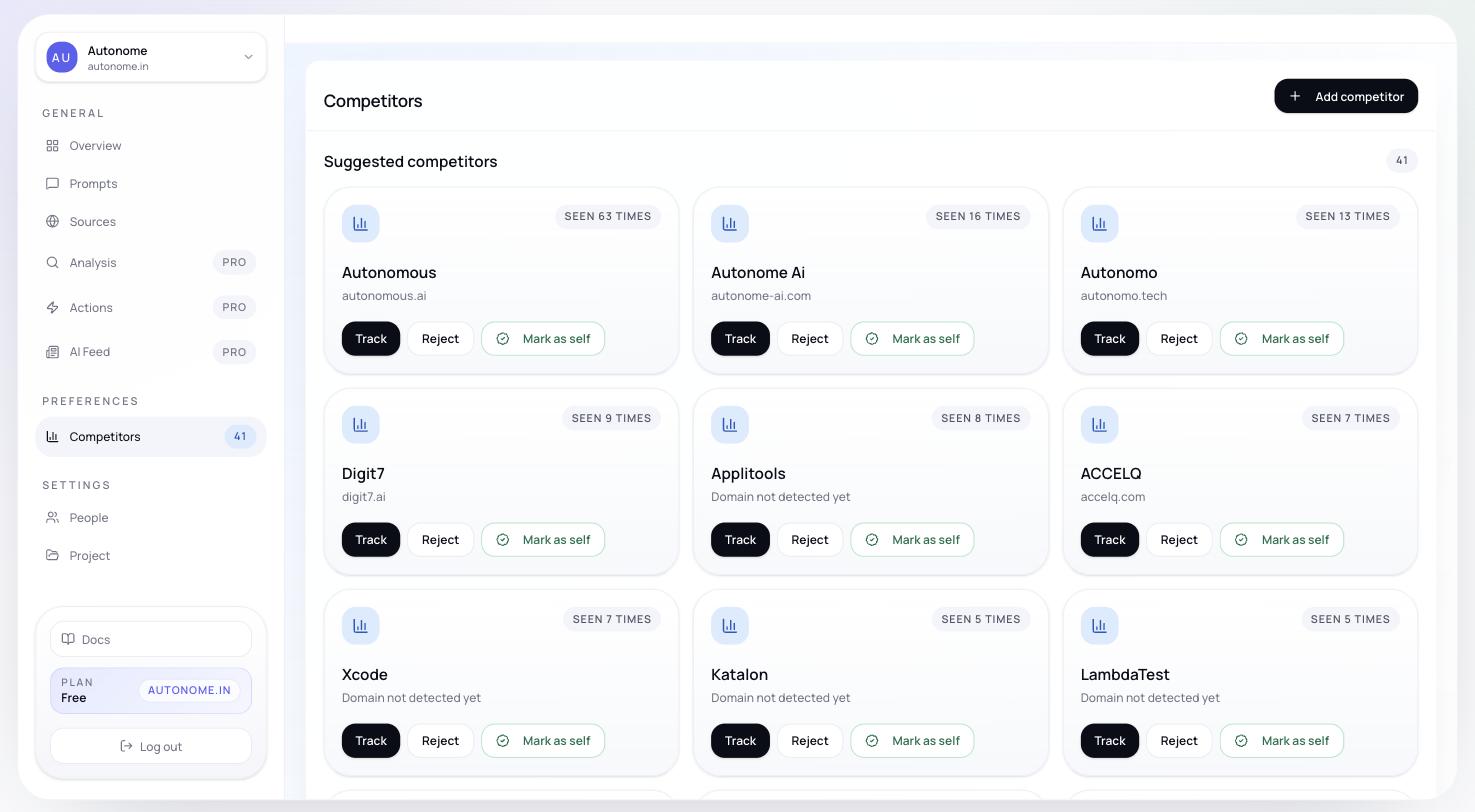
Competitors page showing Suggested and Active competitors
Why it matters
The competitors you mark active become the benchmark set that flows through the rest of the product. Keeping this list tight and accurate means cleaner comparisons in Analysis, more useful source intelligence in Sources, and a more readable overview in Overview.Suggested vs active competitors
Citd may detect many brands across a prompt set. Not all of them are worth tracking directly.
Review the Suggested list regularly. New competitors can appear after each tracking run as Citd sees new brands recommended by AI assistants.
What you can do here
From the Competitors page you can:- review suggested competitors discovered from tracked responses
- accept or dismiss stores you care about
- add a competitor manually by domain
- edit tracked names, aliases, colors, and domains for each active competitor
- keep your comparison set focused on real head-to-head alternatives
What to track for each competitor
For each active competitor, Citd stores:
Aliases are especially important. If a competitor shows up as both “TrailPro” and “Trail Pro” in AI responses, add both so Citd counts them as the same brand.
How competitors flow into the rest of the product
Once a competitor is active, Citd uses that set in:- Overview — side-by-side comparison on Visibility, Share of Voice, and Rank across the same prompt set
- Sources — see where their citation footprint is stronger or weaker than yours
- Analysis — understand why they outrank you on specific prompts, broken down by authority, relevance, and readiness gaps
- Actions — generate fixes from the competitive gaps Analysis surfaces
Next steps
Overview
See competitor performance alongside your own across your full prompt set.
Analysis
Understand why specific competitors outrank you and where the gaps are.
Sources
Compare citation footprints across domains for you and your competitors.
Actions
Generate content and optimization fixes from competitive gap analysis.