

The AI Feed is available on paid plans (Starter and Growth).
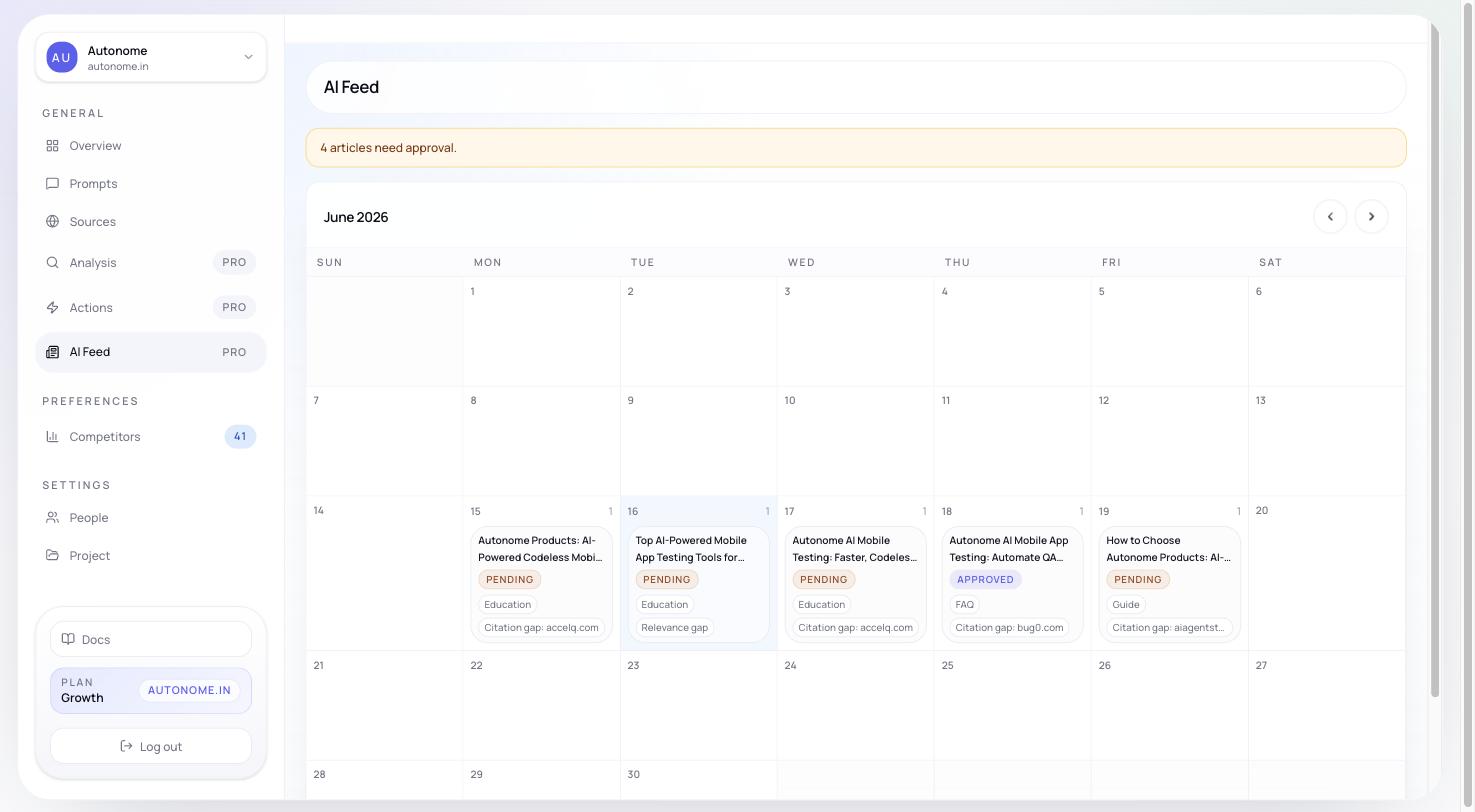
AI Feed content calendar showing planned and published articles for the month
How AI Feed works
Citd maps your goals, audiences, and brand rules to the tracking prompts and competitor gaps in your project, then plans a content calendar. Articles are drafted automatically and queued for your review. You approve, edit, or reject each one before anything goes live.Step 1 — Set up your intake
Before Citd can plan articles, you tell it what your brand stands for. The setup screen appears the first time you open AI Feed. Publishing settings Choose where articles will go:- Shopify blog — Citd publishes directly to a blog in your connected store (e.g.
/blogs/citd-geo). Requires Shopify connected. - Custom website — Citd serves articles through a public feed your site reverse-proxies. See Custom site reverse proxy setup below.
- Manual — articles wait in the calendar for your approval before going live.
- Auto — Citd publishes approved articles automatically on their scheduled date.
Citd pre-fills the intake fields from your project data. Review them and adjust before saving.
Step 2 — Review the content calendar
Once setup is saved, Citd plans a calendar for the current and next month. Each article tile shows:- Title — the planned article headline
- Status — Pending, Writing, Approved, Published, Rejected, or Failed
- Scheduled date — when it is planned to publish
- Planning provenance — why Citd picked this topic (e.g. “Losing to RidgeRun”, “Relevance gap”, “Citation gap”)
Step 3 — Review and approve articles
The article review page is where you read the draft, check the sources, and decide whether to publish.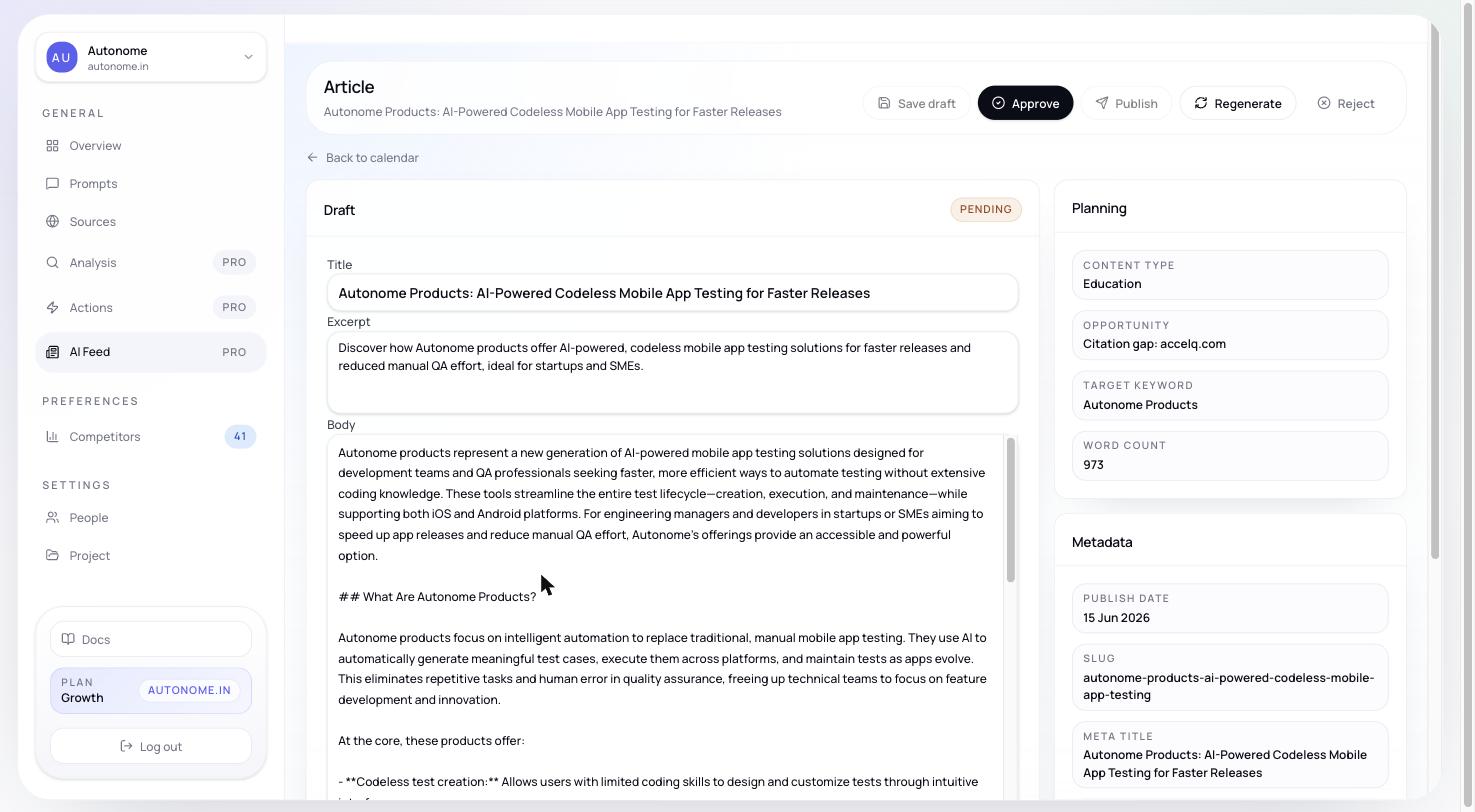
Article review page showing draft content, planning metadata, and research sources
- Draft — editable title, excerpt, and body. Save your edits before approving.
- Planning — content type (comparison, FAQ, guide, etc.), the opportunity it targets, the target keyword, and word count.
- Metadata — publish date, slug, SEO meta title and description.
- Research sources — the citations Citd used. Sources marked Cited appear in the article body.
Actions on the article page
1
Edit if needed
Change the title, excerpt, or body directly in the draft fields. Click Save draft to save your edits without approving.
2
Approve
Click Approve to mark the article ready for publishing. In Manual mode, it then waits for you to click Publish. In Auto mode, Citd publishes it automatically on the scheduled date.
3
Publish manually
In Manual mode, once an article is Approved, the Publish button becomes active. Click it to push the article to your Shopify blog or custom site immediately.
4
Regenerate with feedback
Not happy with the draft? Click Regenerate, add optional guidance (e.g. “focus more on waterproof materials”), and Citd rewrites the article. You can regenerate as many times as needed before approving.
5
Reject
Click Reject to skip an article. It stays in the calendar for reference but will not be published.
Step 4 — Track post-publish impact
After an article publishes, Citd measures whether your visibility metrics moved. The impact result appears on the calendar tile and on the article’s Planning card. Look for the Post-publish impact row.Next steps
Analysis
See the authority, relevance, and readiness gaps AI Feed articles are designed to close.
Actions
AI Feed articles are planned against the same gaps as your Actions queue.
Integrations
Connect Shopify to enable direct blog publishing.
Sources
Understand which external citations influence your authority score.
Custom site reverse proxy setup
This section is for your developer or technical team. If you publish to a Shopify blog, you can skip it.
/blog) and reverse-proxy requests to the Citd Public Feed API.
How the feed works
Citd’s AI Feed is a fully server-side rendered (SSR) HTML feed at:/blog/* to this URL, preserving the path suffix. When a browser requests /blog, it sends Accept: text/html and gets back a styled HTML page. API consumers get JSON.
Setup verification requirements
Before Citd begins publishing articles to your custom site, click Verify Setup in the AI Feed settings. The verifier checks:- Status code — your blog index (e.g.
https://yourdomain.com/blog) must return200 OK, not a redirect (3xx). - SSR marker — the returned HTML must contain
<meta name="citdhq-feed-origin" content="agentrank-feed-origin">or the stringcitdhq-feed-origin/agentrank-feed-origin. - Canonical alignment — the canonical URL tag in the HTML head must match your configured base URL.
- Health check —
https://yourdomain.com/blog/_citdhq/healthmust return200 OKwith theagentrank-feed-originmarker in the JSON response. - Sitemap domain —
/blog/sitemap.xmlmust list URLs on your domain (e.g.yourdomain.com/blog/article) and must not contain rawcitdhq.comorigin URLs.
Integration code snippets
- Next.js
- Nginx
- Cloudflare Workers
- Node.js / Express
- Shopify App Proxy